Posts

The shrine of The 100 Poems

Image
There is a shrine which people call “ the village of The 100 Poems ” in Ohtsu City, Shiga prefecture. And The World Karuta Competitions, which I wrote about in the previous blog, is held there. The official name of this shrine is “Ohmi Shrine”. The shrine is located between Mt. Hiei on which Enryaku-ji Temple is and Biwa-ko Lake, and the shrine is built on the foot of the mountain. So you have to walk up on the long stone-stairs to visit it. When you arrive at the entrance gate from the foot of the mountain, you must be sweating. But yet an upward cool wind from the lake may stop you sweating and the air in the shrine will softly wrap you. Secondly, you will walk to the inner sanctuary on the way across the small-white-stone yards. On entering the sanctuary you may feel the subtle change of the air, the air outside of the sanctuary is naturally clean but the air inside of the sanctuary is sacred. You may not believe that, but it’s true. And it is said that each good shrine has...

Karuta competitions by the 100 Poems

Image
I saw on TV news that many young foreigners competed karuta competitions by the 100 Poems. I was surprised at that, as well as I was interested why they played karuta competitions and why they knew how to play. Because karuta competitions are so difficult that the number of those who play the game isn’t large even in Japan. Eventually, I never have played karuta competitions. Incidentally, the 100 Poems, “hyakunin-issyu” in Japanese, are familiar with Japanese People. Japanese people in most cases learn the 100 Poems in their junior high-schools or high-schools, and they sometimes play a game of competing accuracy and quickness with several people that players grab a card written with the only second phrases of a poem from cards on tatami listening to full phrases of a poem. Of course I learned the 100 Poems in my junior high school and sometimes played the game, but I was a weak player of karuta games. Karuta competitions are a severer sport than the game above, so the sport dema...

The shrine of Daijosai

Image
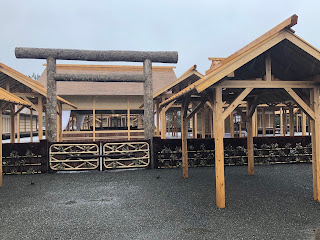
November 23rd is Labour Thanksgivings Day, a national holiday. However, from ancient times, the day has been the most important day when successive emperors have served much harvest, especially new rice, to the God Amaterasu-Ohmikami and prayed for peace in this country and the prosperity of Japanese people. In addition, each emperor has stayed with the god through the night. This ritual on November 23rd is called as Niinamesai. Especially upon the changing of each emperor’s throne a new emperor has the Daijosai Ritual, which happens only one time during his reign. Scenes of which the present emperor did his rites in the Daijosai Ritual were broadcasted on TV news. A wooden shrine of Daijosai was built in the Imperial Palace for the one time ritual. Nonetheless, the shrine is magnificent, so then honestly speaking, it is kind of “mottainai”. However, it is said that building and demolishing the shrine has been a custom since the Muromachi period. On a rainy day November...

The longest shopping street in Japan

Image
The Tenjinbashi shopping street in Osaka is the longest shopping street in Japan. Its length is 2.6km and the street is filled with shops and restaurants on both-sides. Moreover, it is arcaded, so then you can enjoy strolling, eating and shopping in any weather conditions. Liveliness is a keyword of Osaka, it is seen in any area in Osaka, for example, Shinsaibashi or Dotombori, and yet the liveliness on the Tenjinbashi shopping street is historically the starting point in Osaka. Because the street includes praying, laughing, pathos and satire, in fact, the Tenjinbashi Street is the starting point of Osaka citizens’ humanity. The forming of the Tenjinbashi Street The Tenjinbashi Street was built in the Edo Period in the seventeenth century. A dealing center-market of vegetables was founded near the street and many vegetable shops were built on the street. The more shoppers came here, the more other kinds of shops and restaurants were made. As a result, the street grew like th...

Shitenno-ji Temple in Osaka

Image
There is a historical temple in Osaka, which is Shitenno-ji Temple. The beginning of Shitenno-ji Temple, 592, is older than the one of Horyu-ji Temple , which is the oldest existing wooden-built temple in the world. The founder of Shitenno-ji Temple is Shotoku-Taishi , who built Horyu-ji Temple as well.  Unfortunately, Shitenno-ji Temple was devastated in an air-raid of the American army during World War II, and the current temple was rebuilt after the war. So then the value of the buildings of the temple is less than Horyu-ji Temple, nonetheless, the value of the legacy of the temple compares favorably with Horyu-ji Temple, which is one of the world cultural heritage sites. The super characteristic positioning of Shitenno-ji Temple One of the characteristics of Japanese beauty is asymmetry. However, the positioning of this temple is synonymous. Many cathedrals of Buddhism in Japan are constructed with four important buildings, “chumon”:a central gate, “goju-no-to”: a fi...

Horyu-ji Temple(2); the “Seishin-sei” of wa

Image
This picture is “Yumedono”, the dream house, for Shotoku-Taishi in Horyu-ji Tenple . An octagonal temple is rare in Japan, it is said that a priest built it for worshipping Shotoku-Taishi after his death. Nearby Yumedono there is “Chugu-ji Temple” for females. It was built at the same time when Horyu-ji Temple was built and far from Horyu-ji Temple in Ikaruga. It was burned at the same as burned Horyu-ji Temple by a strong enemy, but it was rebuilt there. This picture is “Nyoirin-Bosatsu”, Avalokitesvara in Chugu-ji Temple. It is beautiful, soft and intelligent and the appearance is relaxed but it looks deeply meditated. The statue makes us imagine that Shotoku-Taishi had meditated like this. The seventeen-article constitution Shotoku-Taishi governing Japan first pondered on the interaction with China and the stability of Japan. In China the emperor of “Zui” unified China where many small countries had battled for a long time, so neighboring countries including Japan had fel...

Horyu-ji Temple; a peaceful temple with a legacy

Image
Horyu-ji temple is the oldest existing wooden-built temple in Japan, as well as in the world, and it is the first world heritage site in Japan. “The oldest existing wooden-built temple” is synonymous of Horyu-ji Temple, but the significance of Horyu-ji Temple exceeds the value of the length of the passage of the time. The meaning of this world heritage site is the legacy of the man, Shotoku-Taishi, who had endeavored to build a peaceful country with Buddhism in the dawning period of the beginning of the unity of this country, Japan. The beautiful scenes of Horyu-ji Temple  Standing on the wide path to “Chu-mon” after passing through the big gate, “Nandai-mon”, a sign of the legacy spreads widely in front of you. There is a silent, clearness and peaceful atmosphere. You may perceive something noble as well. Heading in the temple you can first see the five tiered pagoda of Buddhism. This pagoda is one of the most beautiful pagodas of Buddhism in Japan. It has a stable and no...